

Summary
Calgary’s storm season puts roofs through their paces every year, and a little preparation goes a long way. The roofing experts at Big 5 Exteriors have created a checklist that homeowners can use to walk through a practical pre-storm inspection, starting with a ground-level visual scan, checking the attic for early leak indicators, and key exterior trouble spots. You don’t have to climb on the roof to identify most problems, and when you spot something that needs a professional eye, Big 5 has been climbing up on Calgary roofs since 1984.
| Time to Read | ~7 minutes |
| What You’ll Learn |
|
| Next Steps |
|
Every spring, Calgary homeowners watch the forecast and hope for the best. But by the time a hailstorm passes, the damage is already done, and water doesn’t wait to find its way in. The smarter move is a systematic inspection before storm season hits.
The good news is that you don’t have to be a roofer to do this. Most of the checkpoints in this guide can be completed from the ground or from inside your attic. And when things look a little sketchy, or you’d just rather not do it yourself, our team at Big 5 is always here to step in.
Why Calgary Homeowners Should Inspect Before Storm Season
Calgary’s hail season runs roughly May through September, and the city is consistently ranked among the most hail-prone in Canada. That matters because hail damage is often invisible from street level, but it makes your roof very susceptible to water.
A pre-season inspection gives you a baseline. If a storm hits and you file an insurance claim, knowing what was already there versus what the storm caused makes a real difference. It also means you’re fixing a cracked shingle now rather than replacing a water-damaged ceiling later.
It’s worth knowing where your shingles stand in terms of age because Calgary’s climate shortens roof lifespans compared to national averages.
| Material | National Average | Reality in Calgary |
| Asphalt (Standard 3-tab) | 20-25 years | 15-18 years |
| Asphalt (Architectural) | 25-30 years | 20-25 years |
| Metal Roofing | 40-70 years | 35-50 years |
| Cedar Shake | 25-30 years | 15-20 years |
Where to Start Your Inspection

View from the Ground
Walk the full perimeter of your home and look up. Bring binoculars if you have them. You’re looking for:
- Missing shingles or obvious gaps in coverage
- Shingles that are curling at the edges or lifting in the middle
- Dark patches or discolouration, which can indicate granule loss or moisture
- Visible sagging or low spots along the roofline
- Damaged or dislodged flashing around the chimney or roof edges
Also, check your downspouts and the ground around them. Granules are the small, gritty bits that coat asphalt shingles. If you’re finding them collecting around your downspouts or in your eavestroughs, your shingles are wearing down faster than they should.
Check Your Attic
Your attic is one of the best places to catch roof problems before they reach your living space. Grab a flashlight and look for:
- Water stains or dark patches on the underside of the roof deck or rafters
- Visible daylight coming through the boards (if light gets in, water can too)
- Moisture, condensation, or mould on insulation or wood
- A musty smell, which often indicates ongoing moisture buildup
Pay attention to temperature, too. A well-ventilated attic should feel close to outdoor temperature. If it’s quite a bit warmer in your attic than outside, that’s a sign of a ventilation problem, which we’ll cover below.
Key Exterior Checkpoints
If you’re comfortable on a ladder, there are a few specific spots worth a closer look. If not, a professional inspection covers all of these.
Flashing
Flashing is the metal trim that seals joints where your roof meets a vertical surface, like a chimney, dormer, or skylight. It’s one of the most common sources of leaks in Calgary homes. Look for rust, gaps, or sections lifting away from the surface.
Shingle Condition
Up close, look for cracking, brittleness, or shingles that have lost most of their granule coating. Architectural shingles in Calgary generally last 20 to 25 years under normal conditions. Standard three-tab shingles often age out sooner.
Sealant Around Penetrations
Anywhere something passes through your roof, such as a vent pipe, exhaust fan, or skylight, there’s a bead of sealant holding the joint together. Calgary’s temperature swings are hard on sealant. If it’s cracked, dried out, or missing entirely, water will find the gap.
Inspect Your Eavestroughs and Downspouts
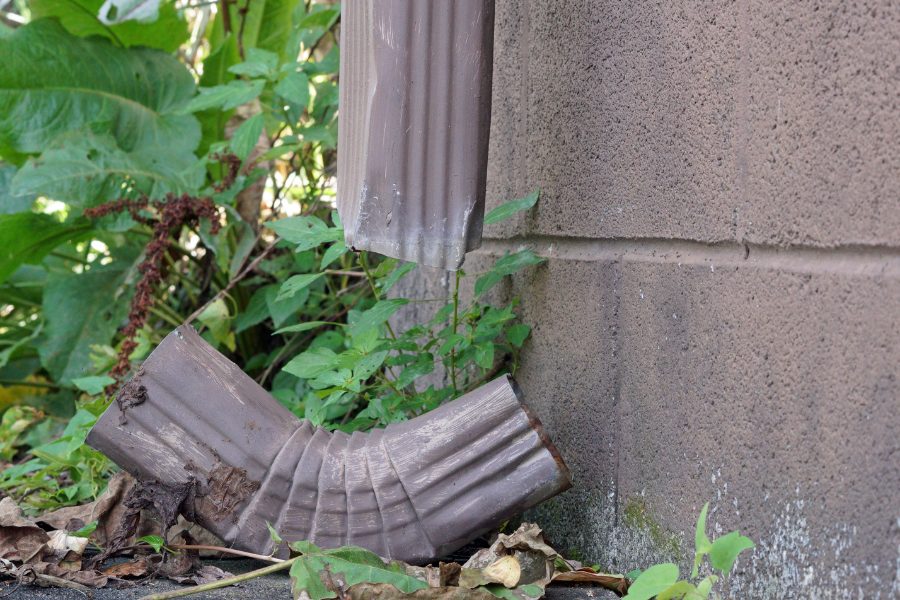
Your eavestroughs are your roof’s drainage system. If they’re not working properly, water backs up under your shingles and along your fascia, creating a direct path to leaks and rot.
Before storm season, check for:
- Visible sagging or sections pulling away from the fascia
- Clogs from leaves, debris, or granule buildup
- Rust stains or holes
- Downspouts that discharge too close to the foundation
If your eavestroughs are already approaching the 15- to 20-year mark, it’s worth having Big 5 take a look. Our turnaround for most eavestrough replacements is about 3 business days, and we offer Alu-Rex Leafguard systems that keep debris out for good.
The Role of Attic Ventilation
Calgary’s climate creates a specific ventilation problem that a lot of homeowners don’t think about until it’s too late.
In summer, a poorly ventilated attic can reach extreme temperatures, baking the underside of your shingles and degrading them from below. In winter, warm air rising from your living space meets the cold roof deck, creating condensation that can lead to mould, rot, and eventually structural damage.
Signs your ventilation isn’t doing its job:
- The attic feels noticeably hotter than outside in summer
- You’ve seen frost or moisture buildup on rafters in winter
- Your shingles seem to be aging faster than expected
A professional can assess your ventilation setup and recommend fixes before the damage compounds.
When to Call a Professional
A visual inspection is a good starting point, but there are situations where you need a trained eye on the roof.
It’s time to call in the pros when:
- You’ve spotted damage and aren’t sure how serious it is
- Your roof is 15 or more years old and hasn’t been inspected recently
- You’ve had a hailstorm in the past year and haven’t had a post-storm assessment
- You’re seeing attic warning signs, but can’t identify the source
- You’re buying or selling and need an accurate picture of the roof condition
At Big 5, we’ve been assessing and replacing Calgary roofs since 1984. A no-obligation assessment gives you a straight answer about where things stand.
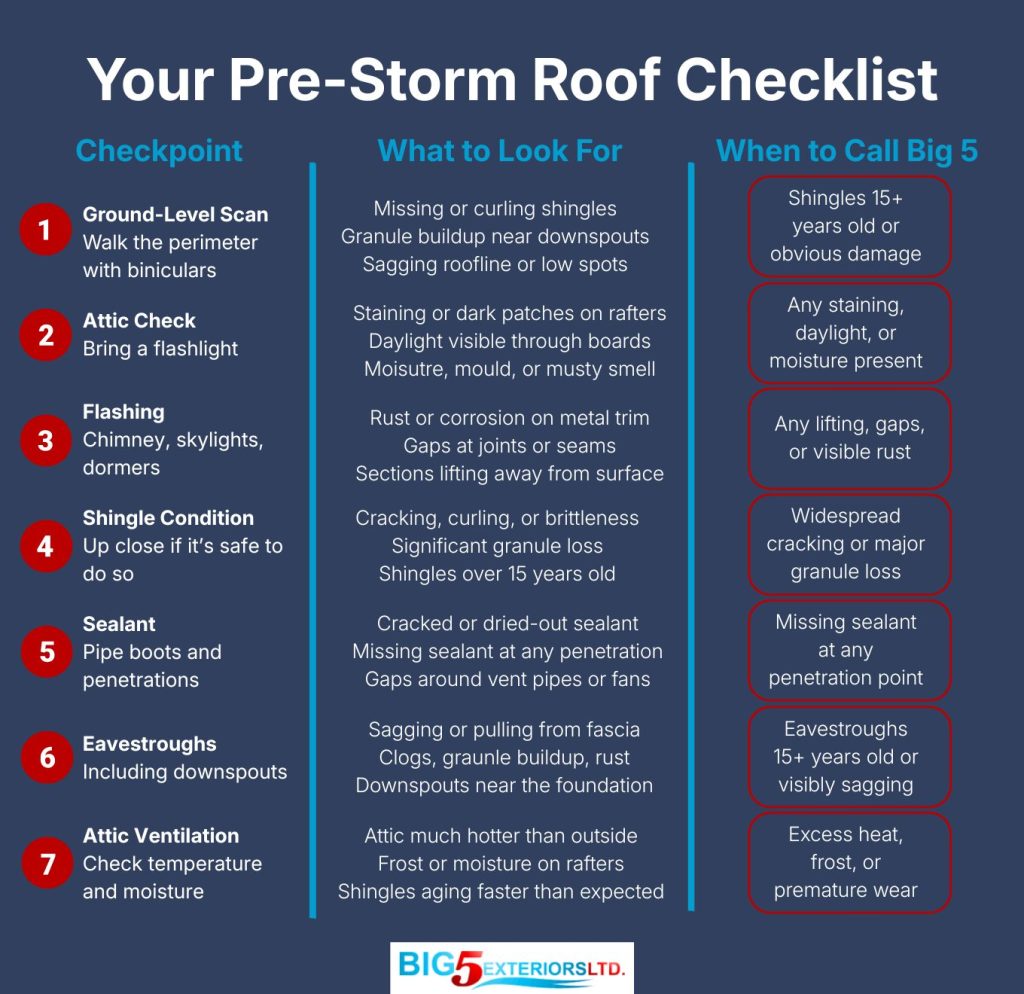
Most of this takes less than 30 minutes, and compared to the cost of repairing water-damaged ceilings, rotted fascia, or a deck compromised by a slow leak, that half hour is time well spent.
Calgary’s storm season doesn’t care whether your roof is ready. But a quick inspection now means you’re not scrambling for a contractor in June when half the city is filing insurance claims after the same hailstorm. Getting ahead of it is always the better call.
If anything on this checklist gives you pause, Big 5 is a phone call (or online form) away. We’ve been doing this in Calgary since 1984, and we’re happy to give you a straight answer about what we find, without any pressure or upselling ever. Reach out online or give us a call at (403) 291-3093 to book your no-obligation assessment today.